


The Work Is There...
The People Are Not.
A reported look at the skilled-trades labor crunch in 2026—and the owners building their way through it.

Introduction
By late morning, Mark's phone has stopped buzzing—not because the problems are solved, but because everyone who needs an answer already has one. Not today. Maybe next week. He hates saying it. He hates what it does to relationships he's spent years building. But there are only so many technicians, and the math never quite works out.
What frustrates him most is that nothing about his business is broken. His pricing is competitive. His reputation is strong. His retention is better than it used to be. And yet, every open role feels like a slow bleed. Each vacancy forces a series of compromises—longer lead times, more overtime, fewer strategic projects—that quietly cap growth.
“I don’t feel like I’m failing. I feel like the rules changed and no one sent the memo.”
— Owner Interview, Hunter Recruitment Advisors
That sense—that the ground has shifted without warning—is what drives most of the anxiety around labor in 2026. Owners are not naïve. They understand cycles. What they are struggling to accept is that this no longer looks like one.
The economist who kept asking: How is the work getting done?
Ron Hetrick didn't come to the skilled trades because of nostalgia or ideology. He came because the data stopped making sense.
"When I wrote Demographic Drought," he said, "I kept sitting there looking at the labor force and I was like, wait a minute—how are we getting work done right now?"
That question—how is this even functioning?—is what eventually pulled him deeper into the non-degree labor market and, ultimately, into skilled trades. He hadn't worked in the trades himself. But as an economist, he was watching a contradiction grow larger every year: fewer young workers entering hands-on careers, yet society's dependence on those careers increasing.
Key Findings
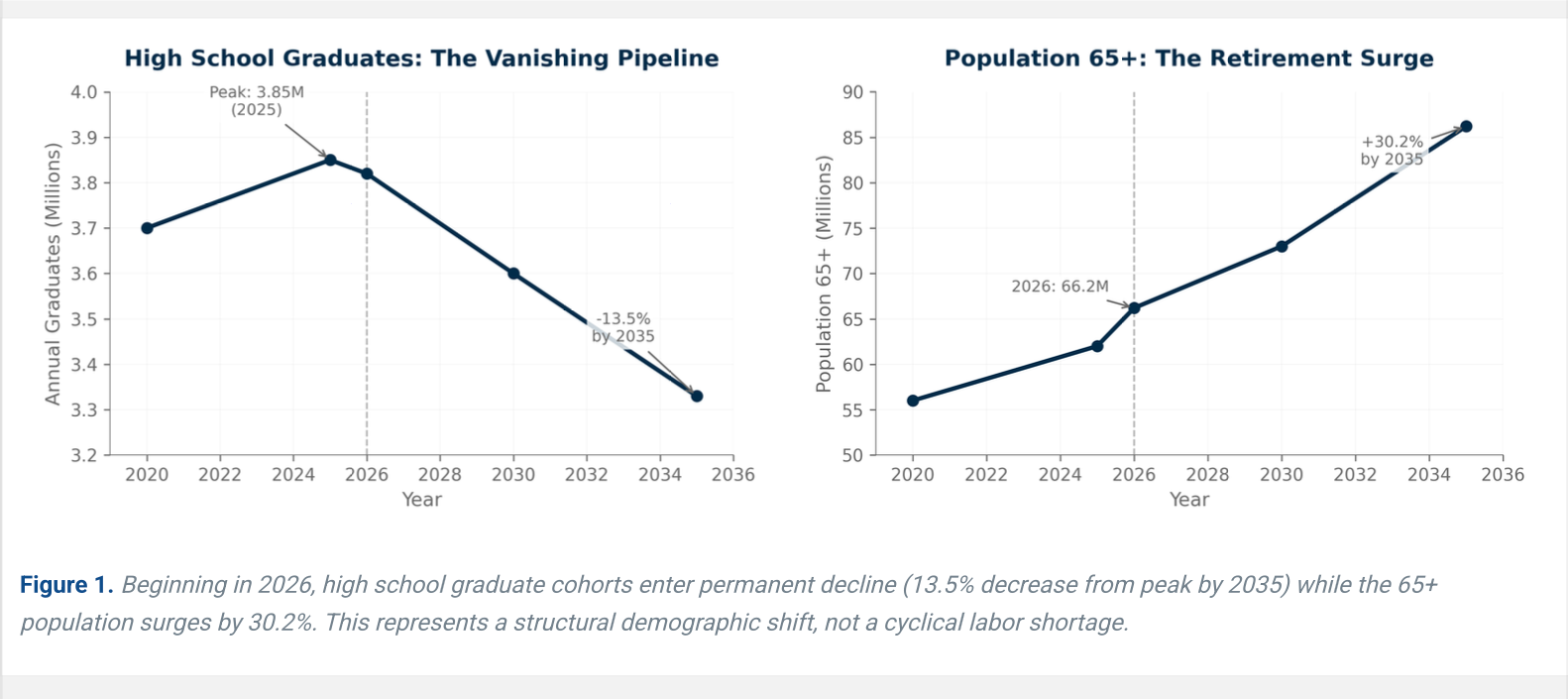
- Demographic permanence: High school graduate cohorts decline 13.5% by 2035 while 65+ population grows 30.2%
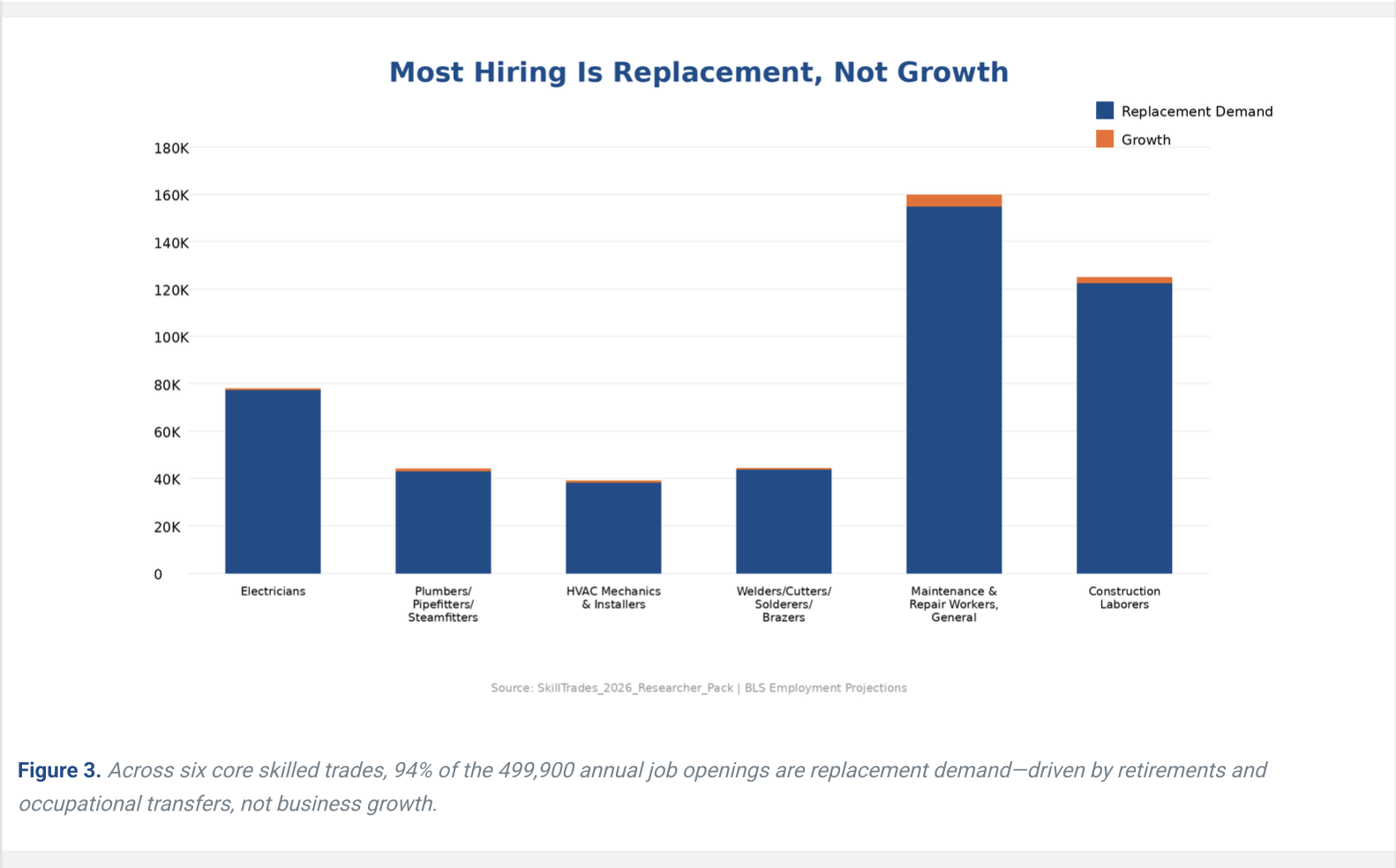
- Structural demand: 94% of 499,900 annual skilled trades openings are replacement needs, not growth
- Influence gap: 75% of students know trades pay well, but only 32% of parents support the choice
- Free-agent dynamics: Wages rose 23% while tenure declined 37% from 2020-2026
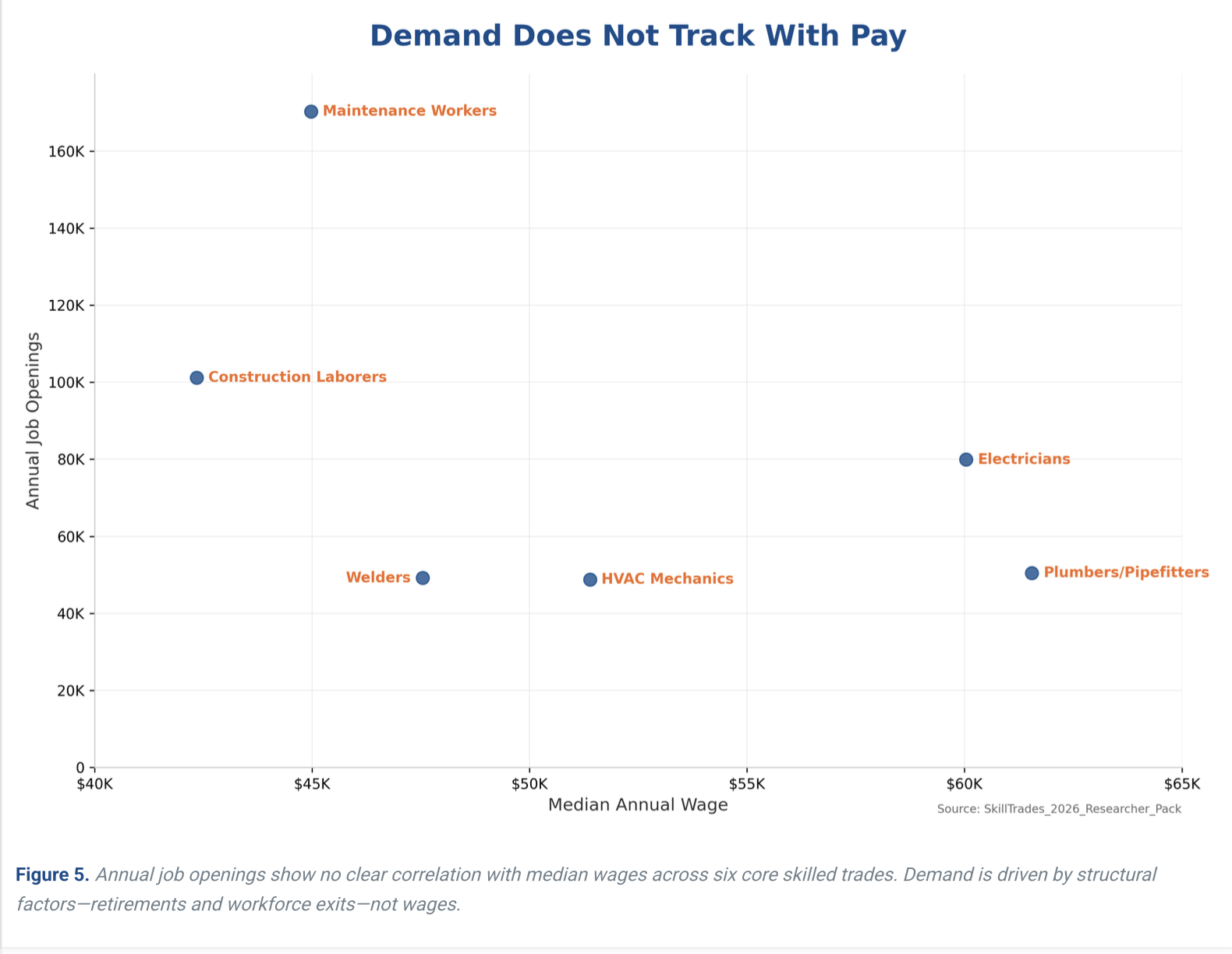
- No wage correlation: Demand shows no clear relationship with pay levels across trades
The Demographic Clock That Doesn’t Reset
Chapter 01
For decades, labor shortages were framed as temporary. Recessions would cool hiring. Booms would reheat it. The pendulum swung. Employers adapted.
The problem with demographics, Hetrick explained, is that they don't swing back.
“This is the last year where we will net an increase in high school graduates... we will graduate fewer and fewer seniors forever.”
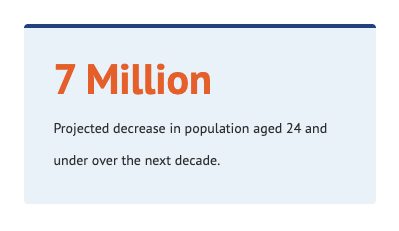
He wasn't being dramatic. He was describing a cohort effect already visible in enrollment data, census projections, and workforce participation rates. Over the next ten years, he said, the population aged 24 and under will decline by roughly seven million, while the population over 65 grows by nine million.
For owners, this isn't an abstract population chart. It's fewer applicants per posting. It's longer time-to-fill. It's a smaller bench when someone leaves. And it explains something owners have been sensing for years but didn't always trust: the labor market isn't tight because of one bad year. It's tight because the replacement engine is slowing.
Why the “College Backlash” Never Materialized
Chapter 02
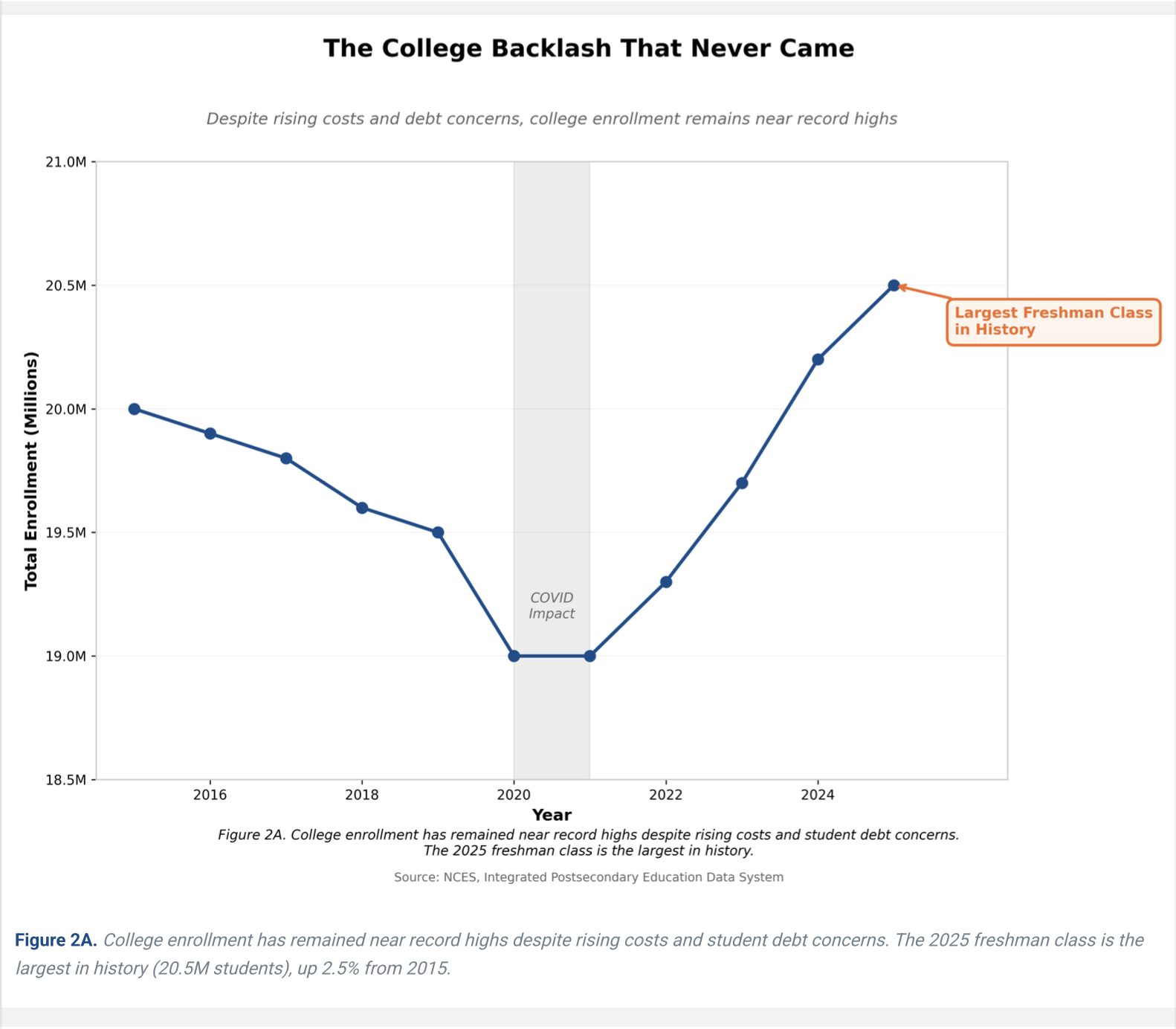
One of the more persistent myths in recent years is that rising tuition and student debt have finally pushed young Americans away from college and back toward trades. It's a comforting story—especially for industries desperate for new entrants. It's also not supported by the data.
"Despite what people say," Hetrick said, "the data just doesn't support it." He pointed to the most recent numbers: the largest entering freshman class in history enrolled just last fall.
That doesn't mean students aren't questioning the value of college. Many are. But questioning is not the same as choosing differently—especially when the social pressure remains one-directional.
“For 30 years, we told everybody, if you don't go to college, you're a loser. And lo and behold, they listened.”
The result is a labor force skewed heavily toward degrees—even as the economy cries out for people who can build, fix, and maintain physical systems. Owners feel this imbalance most acutely when they try to hire entry-level talent. The people they need are being funneled elsewhere before they ever encounter a trade career as a legitimate first choice.
Why the “College Backlash” Never Materialized
Chapter 03
Awareness isn't the problem. Influence is. When Hetrick and his team surveyed high-school students for Who Is Going to Do the Work?, they found something that surprised many employers: most students already know the trades can pay well.
That awareness, however, does not survive the decision-making ecosystem.
"Yeah—young kids, but not their parents," Hetrick said
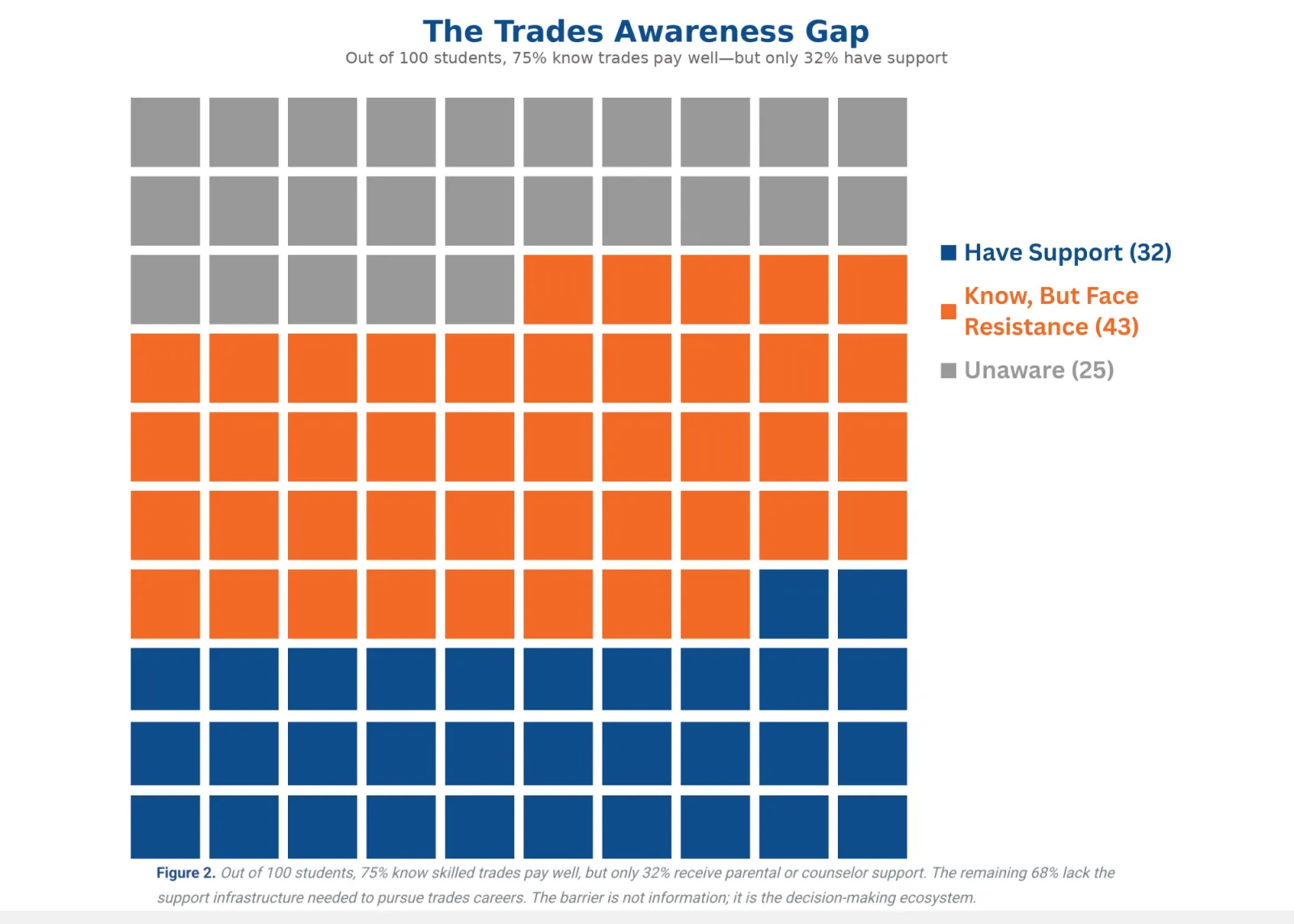
Parents who spent decades hearing that college was the only safe route are understandably reluctant to bless an alternative. Guidance counselors, measured by college placement metrics, reinforce the same message. And peers—perhaps the most powerful force—signal what success is supposed to look like.
By the time a student reaches senior year, Hetrick said, even those who once expressed interest in the trades can be talked out of it when the conversation shifts to dorms, campuses, and acceptance letters. For employers, this explains why job fairs and one-off school visits often disappoint. The decision has usually been shaped long before the booth is set up.
The Owners Who Stopped Waiting
Chapter 04
Some businesses respond to this reality by doubling down on experience requirements—hoping to filter their way to certainty. Others raise wages aggressively, assuming price will solve scarcity.
A smaller group has chosen a different path: they stopped shopping for finished products and started building their own supply. What they have in common is not size or industry. It's a shift in mindset.
“I believe everything can be reduced to one thing... drive. You give me somebody with drive and I can do anything with them.”
When higher wages create a rental market
Linda, the manufacturing owner, describes the modern labor market as oddly transactional. "People aren't joining companies," she says. "They're renting opportunities."
Hetrick has a name for this phenomenon. "This becomes the free-agent rental market," he said.
“You’re not gaining employees—you’re renting them.”
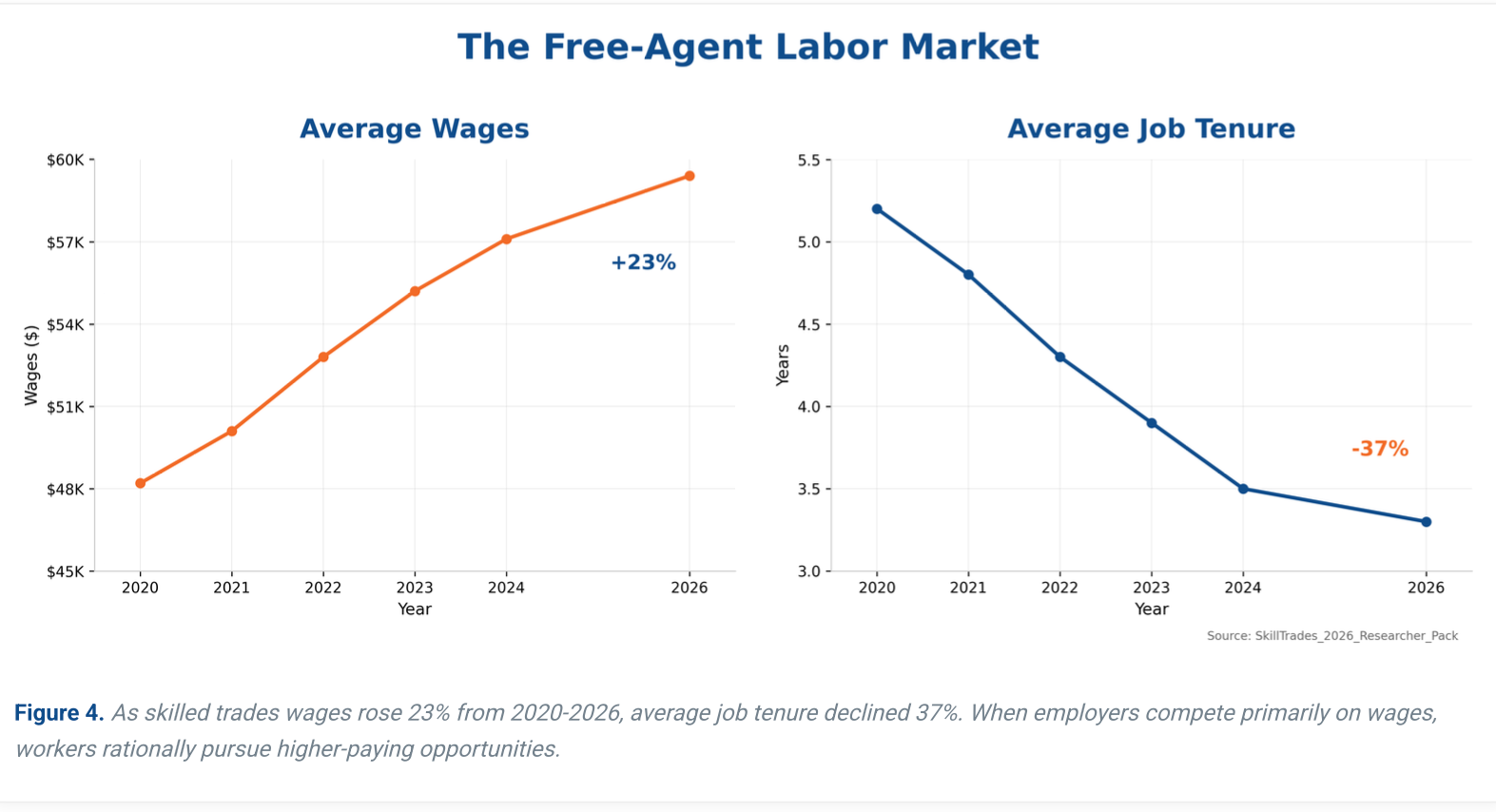
The danger isn't just cost. It's loyalty. When everyone is chasing the same experienced workers, wages inflate faster than attachment. New hires arrive at premiums that incumbents notice. Cultural cohesion erodes. Churn accelerates.
Recruiting becomes persuasion
This is where recruiting quietly turns into marketing. When Wynn says "recruiting is a marketing function," he isn't being metaphorical. He's describing a shift forced by scarcity. If candidates are not actively looking—or are choosing between fundamentally different life paths—then the employer must persuade, not just post.
Strategy: Hire for Traits, Train for Skills
The organizing principle for companies managing to grow despite the shortage.
Apprenticeships are often praised rhetorically and underused operationally. The reason, Hetrick argues, is intent. "Intentionality is the thing," he said. "You should be bringing in someone because you see a future for them in your organization."
The Choice Ahead
Chapter 05
Owners often ask why women and minority candidates remain underrepresented in the trades despite strong demand. Hetrick's answer is careful but candid. Anecdotally, he sees progress. Empirically, the data hasn't moved much. He pointed to stark statistics—occupations that remain overwhelmingly male—and to structural barriers that discourage entry.
Change here, he suggested, requires the same ingredients as early talent generally: exposure, support, and intentional outreach. Waiting for candidates to self-select is not enough.
The quiet advantage of awareness
Perhaps the most underappreciated skill in 2026 is situational awareness. Hetrick urged owners to understand their local labor markets—not just anecdotally, but analytically.
In some counties, he noted, half the population holds a college degree. In those places, hiring trades talent is exceptionally difficult—not because the company is flawed, but because the labor pool is structurally constrained.
What 2026 asks of owners
By the end of these conversations, a pattern emerges. The companies that are coping best are not waiting for relief. They are redesigning how labor enters, moves through, and stays within their organizations. They treat hiring like operations. They treat training like investment. They treat culture like infrastructure.
Conclusion
The skilled-trades labor crisis is not ending in 2026. The demographic math says otherwise. The cultural momentum says otherwise. The replacement needs say otherwise.
What is changing is how clearly the choice is coming into focus. Owners can continue operating as if labor scarcity is an interruption—or they can accept it as a permanent condition and build accordingly.
Those who choose the latter won't eliminate the challenge. But they will stop being surprised by it. They will stop reacting week to week. They will start designing systems that work in the world as it is, not as it used to be. And in a market where the work is abundant but the people are not, that may be the most durable advantage left.
Methodology & Sources
Research Approach
This report is grounded in labor-market intelligence derived from multiple streams of evidence: national workforce analytics, demographic trend analysis, employer-reported hiring conditions, and interviews with skilled-trades economists. The findings reflect converging signals across quantitative datasets and qualitative fieldwork conducted throughout 2025-2026.
Primary Data Sources
Lightcast™ (formerly Emsi Burning Glass): Job postings data, labor supply/demand modeling, workforce transitions, and occupational projections through 2035. Lightcast aggregates real-time labor market data from over 40,000 online sources and integrates federal reporting to provide granular occupational insights.
U.S. Bureau of Labor Statistics (BLS): Employment Projections Program (2024-2034), Occupational Employment and Wage Statistics (OEWS), Current Population Survey (CPS), and Job Openings and Labor Turnover Survey (JOLTS). BLS data provided baseline figures for annual job openings, replacement demand vs. growth demand, median wages, and workforce participation trends.
National Center for Education Statistics (NCES): High school enrollment and graduation projections, postsecondary enrollment trends, and degree completion rates. NCES data informed the demographic cohort analysis underlying Chapter 1.
U.S. Census Bureau: Population estimates and projections by age cohort (2020-2035), with particular focus on the 65+ and under-24 populations. Census data validated the structural demographic shift described in Figure 1.
SkillTrades_2026_Researcher_Pack_AllInOne_Authoritative.xlsx: Proprietary dataset compiled for this report, integrating BLS projections, Lightcast demand modeling, wage trends, tenure data, and replacement vs. growth ratios for six core skilled trades occupations (Electricians, Plumbers/Pipefitters/Steamfitters, HVAC Mechanics & Installers, Welders/Cutters/Solderers/Brazers, Maintenance & Repair Workers General, and Construction Laborers).
Qualitative Research
Expert Interviews: Extended interviews with Ron Hetrick, PhD, Senior Labor Economist and lead author of Demographic Drought and Who Is Going to Do the Work? (Lightcast). Dr. Hetrick's analysis informed the demographic framing, cultural dynamics, and structural workforce challenges discussed throughout the report.
Employer Interviews: Confidential interviews with skilled-trades employers across manufacturing, construction, and home services sectors. Quotes and operational insights (e.g., "I don't feel like I'm failing" and "You're renting employees") were drawn from these conversations, conducted by Hunter Recruitment Advisors between October 2025 and January 2026.
Key Analytical Frameworks
Replacement Demand vs. Growth Demand: BLS projections distinguish between job openings created by workforce exits (replacement demand) and those created by business expansion (growth demand). The 94% replacement figure in Chapter 4 reflects this distinction across the six studied trades.
Demographic Cohort Analysis: High school graduate projections (NCES) were cross-referenced with Census population estimates to model the declining supply of 18-24 year-olds entering the workforce. The 13.5% decline by 2035 is based on birth rates from 2007-2017 cohorts now aging into workforce entry.
College Enrollment Trends: NCES Integrated Postsecondary Education Data System (IPEDS) tracking of fall enrollment from 2015-2025, showing college participation remained near record highs despite discourse around student debt and alternative pathways.
Awareness vs. Influence Gap: Student survey data from Lightcast's Who Is Going to Do the Work? (2024), measuring student awareness of trades wages (75%) against parental/counselor support (32%). The 68% "lack of support" figure aggregates students facing active resistance (43%) and those unaware or lacking guidance (25%).
Free-Agent Labor Market Metrics: Wage growth (+23%) and tenure decline (-37%) from 2020-2026 were calculated using BLS OEWS wage data and CPS median tenure figures for skilled trades occupations. The "rental market" framing emerged from employer interviews and Hetrick's analysis of rising job mobility patterns.
Occupational Definitions
The six skilled trades analyzed in this report correspond to the following Standard Occupational Classification (SOC) codes:
- Electricians (47-2111)
- Plumbers, Pipefitters, and Steamfitters (47-2152)
- Heating, Air Conditioning, and Refrigeration Mechanics and Installers (49-9021)
- Welders, Cutters, Solderers, and Brazers (51-4121)
- Maintenance and Repair Workers, General (49-9071)
- Construction Laborers (47-2061)
Limitations & Caveats
Workforce projections are inherently uncertain and subject to policy changes, economic shocks, immigration dynamics, and technological disruption. The demographic trends described in Chapter 1 assume current fertility rates and net migration patterns hold steady through 2035. Sharp deviations (e.g., substantial immigration reform or unexpected fertility rebounds) could alter the trajectory.
Employer interviews represent a non-random sample of firms actively engaged with recruitment strategy. Findings may not fully generalize to employers in all regions or sectors. Regional labor market variations (college attainment rates, cost of living, industrial composition) can significantly affect local hiring conditions.
Wage and tenure data reflect aggregated national averages. Individual occupations and employers may experience different patterns based on geography, company size, and competitive positioning.
References
Hetrick, R. (2021). Demographic Drought: How the Coming Population Decline Will Change Business and the World. Lightcast.
Hetrick, R. (2024). Who Is Going to Do the Work? Understanding Career Choice and the Influence Gap. Lightcast.
U.S. Bureau of Labor Statistics. (2024). Employment Projections: 2024-2034. Washington, DC: U.S. Department of Labor.
National Center for Education Statistics. (2025). Digest of Education Statistics. Washington, DC: U.S. Department of Education.
U.S. Census Bureau. (2023). National Population Projections: 2020-2040. Washington, DC: U.S. Department of Commerce.
About the Author
Aaron Wynn is the CEO of Hunter Recruitment Advisors, a recruitment process outsourcing and labor-market intelligence firm serving skilled-trades employers across manufacturing, construction, and home services. With partnerships spanning 300+ employers across the U.S. and Canada, HRA specializes in diagnosing hiring constraints, applying real-world labor data, and executing recruitment strategies that reflect current market realities. Wynn has led the firm's shift toward treating recruiting as a marketing function, informed by workforce analytics and demographic trends rather than legacy hiring models.
© 2026 Hunter Recruitment Advisors. All rights reserved.
For inquiries regarding this report or to discuss workforce strategy, contact Hunter Recruitment Advisors at HunterRecruitment.net